
Business
Are branded cold and flu tablets really worth the extra money?
By Katherine Langford
Advertisement · Why this ad?
Katherine oversees editorial operations across all six brands. Before joining The Meridan Group, she spent 14 years at the Minneapolis Star Tribune, where she led the metro desk through its digital transformation. She holds a Master's in Journalism from Northwestern's Medill School.
More from Katherine →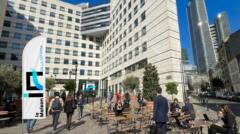
Image source, Evidence Paris By John Laurenson Business reporter , Reporting from Paris Published 56 minutes ago When Roland Cubin walks you round what will eventually be a new Parisian apartment you have to use your imagination. "Here you will be in the kitchen, and here is the bathroom," says the deputy CEO of French real estate company Groupama Immobilier. It all sounds appealing, an upmarket flat in the west of Paris, but presently the space doesn't look like one at all. That's because it's currently a corner of one floor of a nine-storey office building called Le Diamant, where 1,800 people work. Groupama Immobilier intends to convert the entire building into apartments. It should be the first of many such office-to-apartments conversions in the surrounding area. We are in La Défense, the purpose-built, business district of the French capital, where the city has congregated its modern skyscrapers. Mirroring a similar trend in places such as New York, Washington DC and London; Paris La Défense, the public development authority that runs the area, has unveiled plans to turn up to a fifth of the office buildings into housing. Cubin leads us into what is currently a conference room in the centre of the building. It has no windows, which is indicative of a big challenge when turning offices into apartments – what to do with the large amount of space in the middle of every floor that doesn't get any natural light. "There won't be any rooms there. Just access," says Roland Cubin, in reference to lifts and stairs. Other issues include the need for more plumbing, and ceilings that can be too low. Despite these challenges, there is a simple reason why there are plans for so many conversions – demand for offices in La Défense and across Paris has plummeted since the Covid-19 pandemic and the growth of homeworking. Image source, Getty Images "La Défense has a vacancy rate of 14-15% which is higher than it used to be," says Pierre-Yves Guice, CEO of Paris La Défense. He adds that another reason for the conversion programme is the need to transform the business district from a place where the only thing people do is work. "To retain companies in France and in Western Europe we need to diversify these office landscapes of the last century, because no-one wants to work in such an environment any longer," says Guice. Ludovic Delaisse, CEO of the French arm of the Canadian real estate business Colliers, says that demand for office space in Paris has fallen by almost a third over the past five to six years. He adds that office high rises will continue to be needed, but that cities need to make sure that leisure time can be enjoyed around them, such as having restaurants, bars, cinemas and gyms on their doorstep. "People like the idea of grouping together in a centre of expertise [for work] - in tech hubs, for example. The challenge for La Défense is to be a place where you want to be, that you want to see when you leave work in the evening." Image source, DC.gov Inspiration for La Défense can come from Washington DC and New York City, where tax cuts for property developers are fuelling the largest amount of office to apartment conversions in the US. Like in Paris, this is in response to falling demand for office space since the pandemic. A report last year , external found that 8,310 converted flats were in the pipeline in New York, and 6,533 in Washington. In third place was Los Angeles on 4,322, followed by Chicago on 3,606. "We set a goal of introducing 15,000 new residents downtown by 2028 and we are now on track to doing that," says Washington DC's deputy mayor for planning and development Nina Albert. She says that while "there may be one or two pretty significant building demolitions… the majority are office conversions". As in Paris, they've faced technical challenges. They've sometimes solved the natural light problem in the middle of office buildings by creating atriums – light sinks in other words – in the middle of them. Albert adds that about "hundreds of millions of dollars of private investment" has flooded into the sector. In addition to tax cuts, the DC Department of Buildings, part of the Council of the District of Columbia, has eased planning restrictions to make it easier for office conversion schemes to gain official approval in the US capital. It's a similar case in New York City. In the UK, there are also tax cuts and eased planning rules , external for converting offices into apartments. This has led to a continuing boom in conversions. A report last year by property firm Knight Frank said that the number of such projects in London were 60% higher , external than pre-Covid levels. Back in Paris, Cubin hopes that French authorities follow these examples and reduce both taxes and rules regarding conversions. "Just how the government deals with the tax question will decide whether France will be able to convert 2% of its vacant offices or 18 to 23%," he says. "And at the moment, when you transform a building in a way that changes its function, it is classed not as an old building that's been changed but as a new building with all the regulatory demands that go with that regarding car parking spaces, wheelchair access, fire safety and so on." Related topics Paris France Washington DC New York City International Business World of Business Housing Housing market Regeneration More on this story As Christmas rush looms, how do China-made toys find their way to the US? Published 15 October How oil-rich Alberta's economy might fare if it broke away from Canada Published 8 October
By Katherine Langford

By Marcus Chen

By Katherine Langford

By Katherine Langford