Technology
Lock Your GitHub Actions
By Marcus Chen
Advertisement · Why this ad?
Marcus manages the day-to-day editorial workflow across all brands, coordinating coverage assignments and ensuring editorial standards are met. He previously served as city editor at the Pioneer Press and holds a degree in Political Science from Carleton College.
More from Marcus →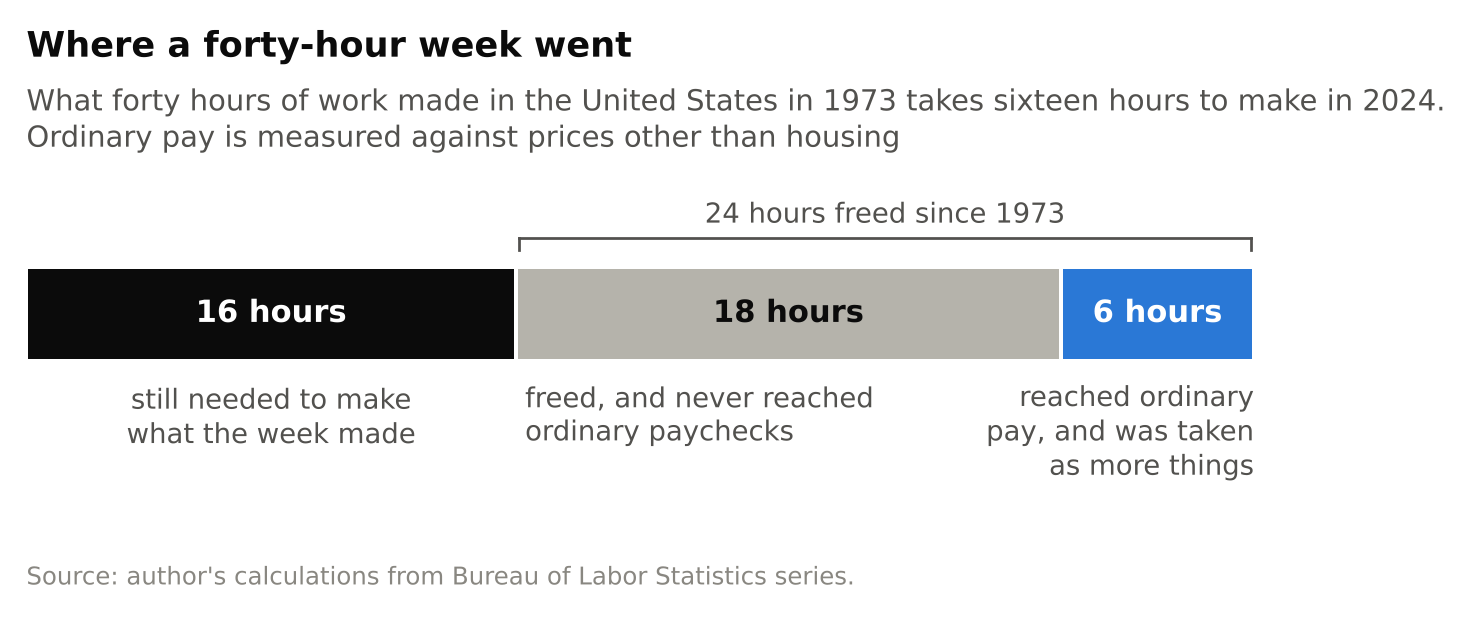
Why Are We Still Working This Hard? In 1973, what a forty-hour week of work produced takes sixteen hours to produce today. That’s according to Bureau of Economic Analysis (BEA) input output tables. An hour of work in American business now makes two and a half times what it made in 1973. For every forty hours that used to be needed, twenty-four have been freed. You have probably not noticed them. The forty-hour week was written into American law by an act of 1938, and hasn’t changed. Counted for each head of population, the hours worked in American business in 2024 were 10 percent higher than in 1973. As a country, the US took the whole of fifty years’ progress as more output and none of it as time. It was supposed to go differently. In 1930 the economist John Maynard Keynes wrote a short essay about the world his grandchildren would live in. He predicted that “the standard of life in progressive countries one hundred years hence will be between four and eight times as high as it is to-day.” And with so much plenty, he thought, we would hardly need to work at all: “Three-hour shifts or a fifteen-hour week” would be enough. He is usually said to have been right about the wealth and wrong about the leisure. Output per person in the United States in 2024 was 7.8 times its level in 1930. But look again at the sixteen hours. He was right about both. The fifteen-hour week arrived in terms of output, but not in the workweek. I have spent a long time trying to find out where those twenty-four hours went, with a co-author, a small economy built on paper, and more national accounts than I’d like to admit. This essay is what I found. Eighteen of the hours never reached ordinary paychecks. The other six reached them in a form that couldn’t be taken as time. Both happened for the same reason, which has to do with what a wage is for. The same reason explains why people are frightened of machines that ought to be good news. And it points to a way out that is simpler, and nearer, than I expected when I started. A note: The numbers are American, because the United States publishes the accounts this needs. I live in Sweden but it’s probably quite a similar story. The formal paper underpinning this work is here: https://papers.ssrn.com/sol3/papers.cfm?abstract_id=7226858 What is a wage for? Three things: A wage is a price. It tells a business what an hour of someone’s time costs, so that the hour gets used where it is worth most, and it tells people which work is wanted. A wage is good at this. A wage is also a “ticket”. It is how nearly everyone gets a share of what is made. Bread reaches me because I have money, and I have money because I sold some hours. That isn’t a law of nature. It is an arrangement, and it has worked so well for so long that we’ve stopped seeing it as one. And a wage is a place: a shape to the day, people to be among, a sign that somebody needs you. One thing can do three jobs only while the jobs pull the same way. For two centuries they did, because of the kind of machine we had. The machines of the industrial age were strong and stupid. They could lift, spin, stamp and haul, and they couldn’t see, judge or decide. Nearly everything worth making took both kinds of ability, so every new machine needed people standing next to it, and the owners of machines had to bid for those people. The price of an hour rose with everything else, and a ticket made of that price was a good ticket. The machines being built now can see, read, write and decide. I write software for a living and use them every day, and I find it harder each year to name a kind of work that is safely out of their reach. My claim is that the price and the ticket have been pulling apart for fifty years, and that each is damaging the other, and that fundamentally this is driven by changes in technology. How important is this? Probably a lot. It surprises me just as much as you that some random 26 year old trans girl might work this out, but the maths has been checked, the paper is going through review, and I’ve done everything I can to try and break it. If you can see what’s really wrong with it: [email protected] Follow a dollar you spend in a shop. Some of it pays the people who worked to make the thing. Some of it pays whoever owns what was used to make it: the oven, the truck, the building, the ground underneath. America’s national accounts are detailed enough to chase a dollar all the way back through every supplier, and when you do it for 2023, of what is paid to Americans for making the things households buy, 66 percent is pay for work and 34 percent goes to owners. A third of the economy, in other words, already pays people for owning things, with no work asked of them. That would be a curiosity if we all held a bit of both. We don’t. The poorest tenth of American households lives mostly on government benefits. From the second tenth to the ninth, about four-fifths of what a household earns in the market is pay for work. Then, in the richest tenth, it changes all at once, and pay and ownership are about half and half. That one tenth receives two-thirds of all the income from ownership. Benefits look like a second source for everyone else. But 68 cents of every tax dollar in America is raised from pay for work, so a benefit is mostly a claim on somebody else’s wage. Follow the money far enough and nine households in ten are living on each other’s wages. We live off the earth and off the machines we’ve built on it. Our share of what they produce reaches us through one narrow channel, which is being paid for a job. By the way at this point you may notice that “machines” sounds like capital, and yes, that would be the technical term. But to try and escape what we usually feel when we hear those terms, I will use work instead of labor, machines instead of capital, and land instead of non-produced inputs (the term used in our paper). Where did the eighteen hours go? Until 1973, what an hour of work produced and what an hour of ordinary pay could buy rose together. Between 1950 and 1973 the first rose by 81 percent and the second by 66 percent. (By ordinary pay I mean the hourly pay of everyone on a private payroll who isn’t a manager or a supervisor, measured against the prices of everything except housing.) Then they parted. Since 1973 the output of an hour has risen two and a half times, and an hour of ordinary pay buys 19 percent more. You might have heard of this as “the great stagnation” and yes, I claim to in large part be able to explain what happened, that technology is what changed. Consider that moors law is usually said to start around that period, and you begin to see what I mean. So to buy what forty hours of ordinary pay bought in 1973 now takes thirty-four hours. Making it takes sixteen. The eighteen in between went somewhere else. I would like to tell you they went to the owners of the machines. About a fifth of the gap did. About two-fifths of it is pay spreading out among workers, with the top pulling away from the ordinary worker. The rest I can’t separate cleanly. It is a tangle of prices, benefits and measures that don’t line up. But look at what the largest piece is. Daron Acemoglu, who shared the Nobel prize in economics in 2024, and Pascual Restrepo estimate that between 50 and 70 percent of the change in America’s wage structure over the four decades to 2016 came from “relative wage declines of worker groups specialized in routine tasks in industries experiencing rapid automation.” Machines learned to do what ordinary workers did before they learned to do what the best-paid did. So both pieces are the same thing happening. A wage is a price, and a price follows scarcity. It doesn’t follow effort, and it doesn’t follow need. The day a machine learns your job, you are working exactly as hard as you did the day before, and your hour is worth less. That is how a price ought to behave, and it is a fine way to decide who should do w